Kuzushiji (Japanese Cursive Characters)
updated on
by Humanities Room
This webpage introduces key resources for researching and learning kuzushiji (cursive characters).
1. Understanding Kuzushiji
The term kuzushiji refers to handwritten characters in which the strokes of standard kaisho (block) script have been abbreviated, as well as printed books that reproduce such handwritten forms.
Among kuzushiji, kana characters whose shapes differ from the hiragana commonly used today are called hentaigana (variant kana). The Chinese characters that serve as the original forms of each kana (before they were written in a cursive style) are referred to as jibo (base characters).
(Reference)
- Tomoko Nakanishi, Kogi 2: Kuzushiji (Lecture 2: Kuzushiji), National Institute of Japanese Literature 2025)
This material, used in the 23rd Training Course on Japanese rare books and old materials co-organized by the National Institute of Japanese Literature and the National Diet Library, provides an overview of kuzushiji. In addition to this material on kuzushiji, the texts used for the Training Course on Japanese Classical Books can be downloaded from the National Institute of Japanese Literature Repository in the National Institute of Japanese Literature. - Hentaigana for Scholarly Information Exchange: List of Hentaigana (National Institute for Japanese Language and Linguistics)
This resource lists Hentaigana together with the corresponding modern hiragana and the jibo (base characters) from which they are derived. Some of these characters have been encoded in Unicode, and the "NINJAL Hentaigana Font" provided by the institute can be downloaded for use with these characters.
2. Using Dictionaries and Character Dictionaries
2-1. Major Dictionaries and Character Dictionaries
This section introduces major dictionaries and character dictionaries that are useful for researching kuzushiji.
- Kota Kodama, ed., Kuzushiji yorei jiten (Dictionary of kuzushiji usage examples) (Tokyodo Shuppan, etc.)
In this dictionary, users first infer the original kanji character and then search for it by radical, total number of strokes, or on/kun readings. By the same author, Kanji kuzushikata jiten (Dictionary of cursive kanji forms) (Tokyodo Shoten, etc.) is a companion dictionary that extracts only the explanations of how to write kanji in kuzushiji from this volume. - Kota Kodama, ed., Kuzushiji kaidoku jiten (Dictionary for deciphering kuzushiji) (Tokyodo Shuppan, etc.)
A dictionary that arranges kuzushiji characters according to the order in which the strokes are begun, allowing users to identify the original kanji from the way the character is written. - Kenji Emori, editor and author, Sosho kensaku jiten (Dictionary for searching cursive script characters) (Sanseido, 2007, NDL Call No. KC612-J1)
The "Guide Marks for Searching" printed on the front and back endpapers presents 460 typical cursive forms of radicals and other components. Even when the radical of a character cannot be identified, these guide marks can be used as clues to look it up. A total-stroke index and a list of radicals are provided at the end of the volume. - Yukihiko Hatano, supervisor; and Tokyo Tegami no Kai, ed., Kuzushiji jiten (Dictionary of kuzushiji) (Shibunkaku Shuppan, 2000, NDL Call No. KC612-G31)
Based on autograph letters written by more than 400 individuals---including emperors, court nobles, military commanders, monks, tea masters, men of letters, and merchants---this dictionary reproduces approximately 35,000 characters in actual handwriting. It enables users to study both kuzushiji forms and the actual movement of the brush. A radical index appears at the beginning, and total-stroke and on/kun reading indexes are provided at the end. - Tatsuo Inoue, supervisor, Nihon nanji itaiji daijiten (Comprehensive dictionary of difficult and variant characters used in Japanese), Character Volume and Deciphering Volume (Yushikan, 2012, NDL Call Nos. KF45-J118 and KF45-J119)
The Character Volume contains around 12,600 variant characters and about 9,500 cursive forms from classical Chinese texts, such as kuzushiji. In this work, "variant characters" are defined as characters whose shapes differ from both the joyo kanji (common forms) and the kyujitai (traditional forms). The characters are arranged by radical, with an index of on/kun readings at the beginning. The Deciphering Volume is an index of variant characters by total stroke count, listing each variant together with the corresponding standard character currently in use.
2-2. Using Sample Texts and Usage Examples
This section introduces resources that allow you to research kuzushiji using sample texts and examples of actual usage. The following character dictionaries related to historical documents include numerous examples of real texts and their usage.
Ancient to Early Modern Period
- Yoshihiko Iwasawa [et al.], eds., Komonjo bunrei daijiten (Comprehensive dictionary of sample texts from historical documents) (Kashiwa Shobo, 1980, NDL Call No. GB8-80)
This dictionary reproduces about 4,000 representative sample texts from historical documents in photographic facsimile. An index of approximately 15,000 entries is provided at the end of the volume.
Early Modern Period
- Shigeo Negishi, supervisor, Edo hanpon kaidoku daijiten (Comprehensive dictionary for deciphering Edo-period printed books) (Kashiwa Shobo, 2000, NDL Call No. KC612-G36)
This dictionary contains about 45,000 kuzushiji (kanji and kana) words and phrases used in Edo-period printed books. Each entry provides a transcription in modern type and a citation of the source. The entries are drawn from 190 printed volumes published mainly in the Edo period and the early Meiji period. Kinsei hanpon kuzushiji daijiten (Comprehensive dictionary of kuzushiji in early modern printed books) (Kashiwa Shobo, 2024, NDL Call No. KC612-R8), published in 2024, is a retitled, reduced-size edition of this work; the contents are identical. - Hideo Hayashi, supervisor, Onkunbiki komonjo daijisou (Comprehensive dictionary of characters in historical documents indexed by on and kun readings) (Kashiwa Shobo, 1999, NDL Call No. GB8-G38)
This work allows users to look up characters by their on and kun readings. It contains about 14,000 head entries and roughly 30,000 examples of characters and their usage. A more accessible edition is available as Onkunbiki komonjo jiten (Dictionary of characters in historical documents indexed by on and kun readings) (Kashiwa Shobo, 2004, NDL Call No. GB8-H18). - Shigeo Negishi [et al.], eds., Komonjo jisou (Dictionary of characters and expressions in historical documents) (Kashiwa Shobo, 1990, NDL Call No. GB8-E30).
Based on more than 2,000 historical documents and records, this work contains about 23,000 vocabulary examples and around 4,200 sample sentences. - Hideo Hayashi, supervisor, Kaidoku kinsei shojo taikan (Comprehensive guide to deciphering early modern letters) (Kashiwa Shobo, 2001, NDL Call No. GB39-G41)
This volume reproduces letters dating mainly from the Edo period through to the late Meiji 30s (early 1900s). Hideo Hayashi, supervisor, and Kiyofumi Amano, ed., Kinsei kuzushiji shojo daijiten (Comprehensive dictionary of early modern kuzushiji letters) (Kashiwa Shobo, 2025, NDL Call No. GB39-R9), is a retitled, reduced-size edition of this work; the contents are identical.
3. Using Websites and Web Applications
This section introduces websites and web applications that are useful for researching kuzushiji.
Multi-database Search System for Historical Chinese Characters (Nara National Research Institute for Cultural Properties)
This system allows cross-searches, using individual characters as search keys, across images of historical character forms made available in databases in Japan and overseas, including "Mokkanko -- Wooden Tablet Database" (Nara National Research Institute for Cultural Properties), the "Denshi Kuzushiji Jiten Database" (Historiographical Institute, The University of Tokyo), and "NIJL Character Shape Search β" (National Institute of Japanese Literature).MOJIZO: Image Matching Search for Mokkan or Cursive Characters (Nara National Research Institute for Cultural Properties / Historiographical Institute, The University of Tokyo)
From an image file, you can perform image-based searches for similar character images recorded in Mokkanko -- Wooden Tablet Database and the Denshi Kuzushiji Jiten Database. Searches are carried out by one character at a time.Kuzushiji Dataset (Center for Open Data in the Humanities)
This is a dataset of kuzushiji character images collected from digitized rare books and old materials. Through the "Kuzushiji Database Search (hiragana, including hentaigana, katakana, and kanji)" interface, you can search for images by character or by character code.AI Kuzushiji OCR Service (Center for Open Data in the Humanities)
This service provides the following apps and web services for reading kuzushiji.miwo: App for AI Kuzushiji Recognition
A mobile app for recognizing multiple Kuzushiji characters. It loads images taken with a smartphone or tablet, as well as images downloaded from the internet, and helps you decipher kuzushiji appearing in those images.
Please note that the use of camera functions is prohibited inside the National Diet Library; please refrain from using the app in the Library.KuroNet AI Kuzushiji OCR Service
A browser-based service that deciphers kuzushiji in IIIF-compliant images and performs recognition of multiple characters. The service is provided free of charge, but login is required.
Except for some items, rare books and old materials in the National Diet Library Digital Collection are IIIF-compliant. By copying the IIIF manifest URI shown in the bibliographic information for each item and pasting it into the KuroNet AI Kuzushiji OCR Service, you can also use the service to help decipher kuzushiji in rare books and old materials from the National Diet Library Digital Collection.Metom Kuzushiji Recognition Viewer
A browser-based service for decoding kuzushiji in IIIF-compliant images. It recognizes one character at a time, and no login is required.
Next Digital Library
This database allows you to search approximately 350,000 digitized books, including rare books and old materials, whose copyright term has expired. By using the "Keyword search" function, you can run full-text searches across about 80,000 rare books and old materials held by the National Diet Library.
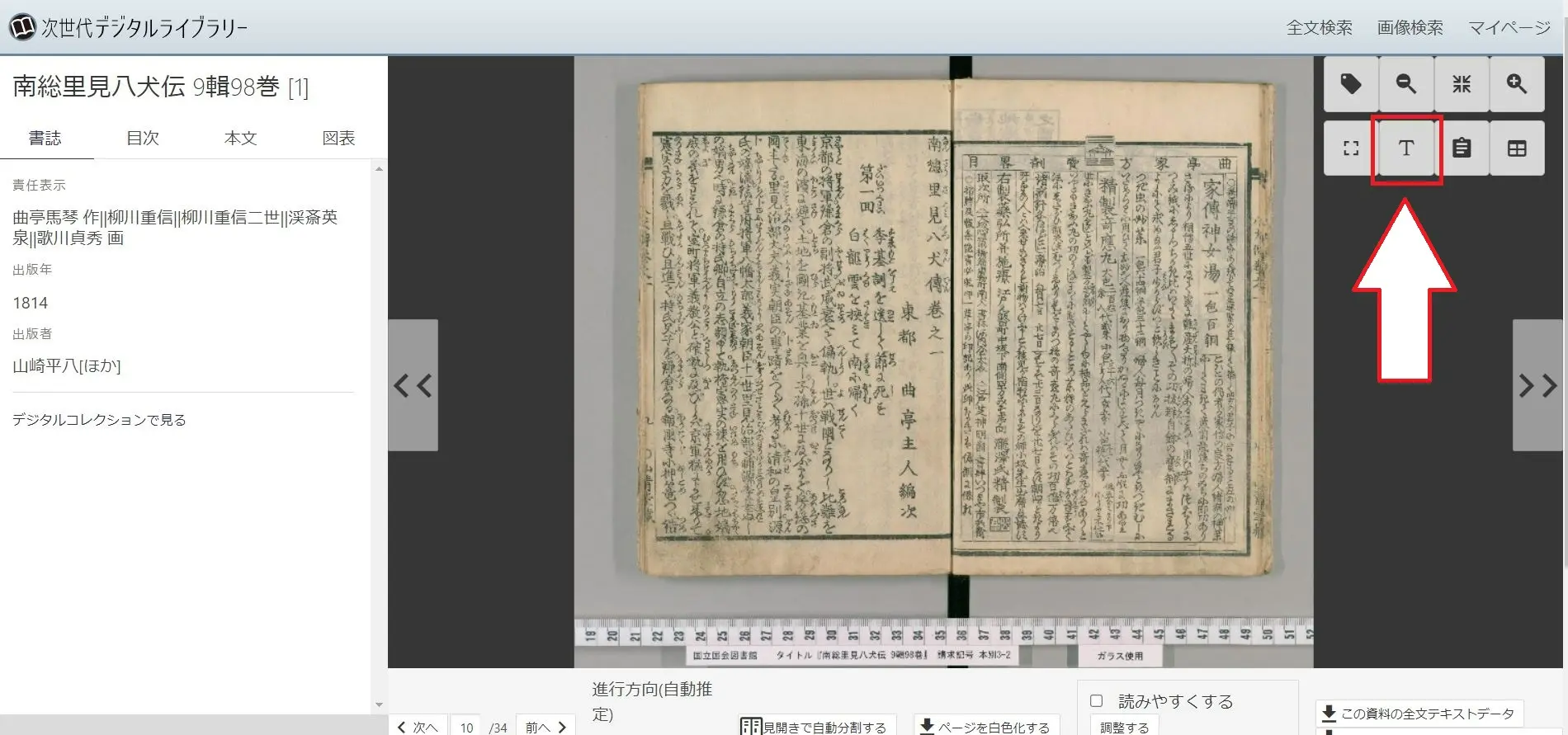
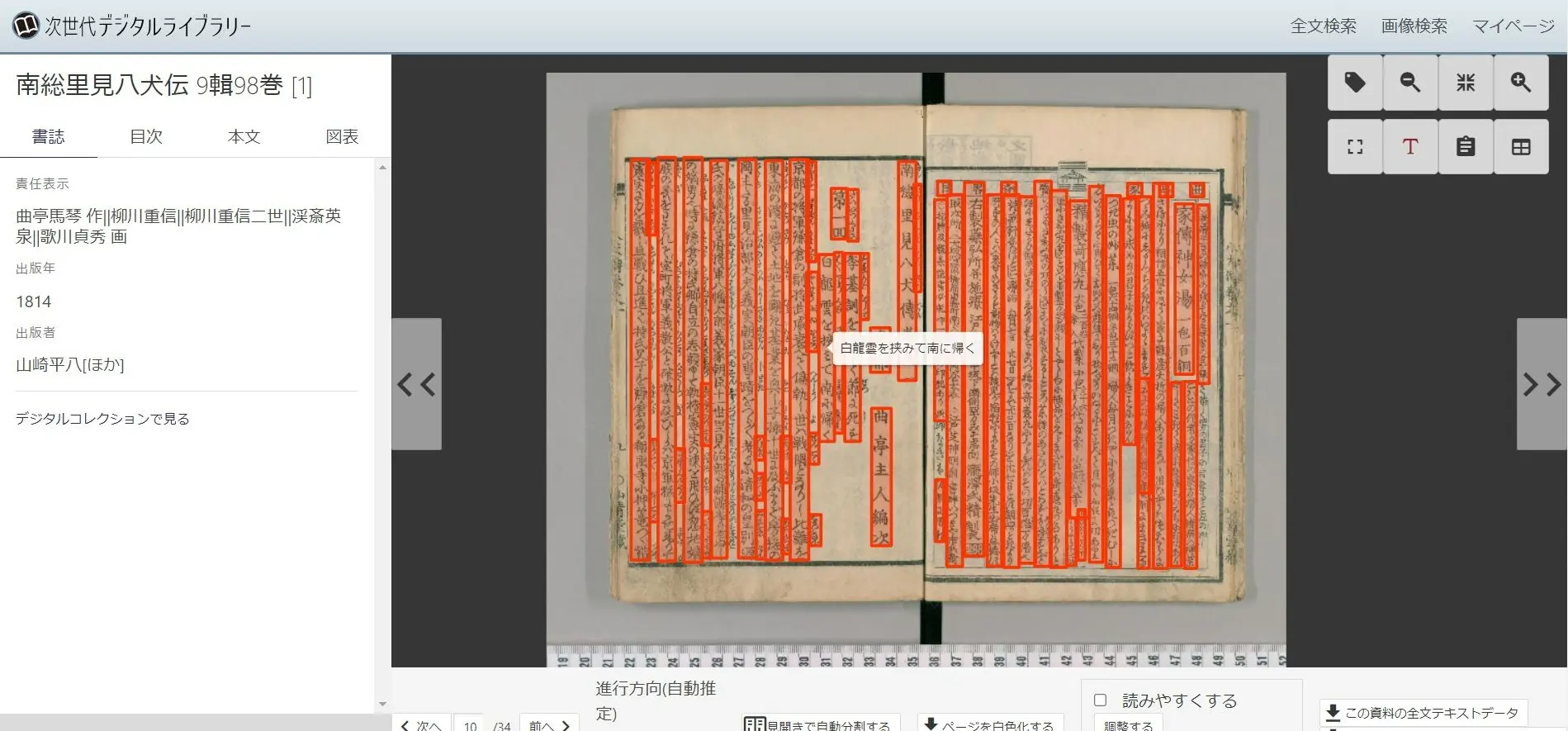
By using the "Show text for each rectangle" function, you can display OCR text corresponding to the passages in the images. This is useful when you wish to examine kuzushiji in rare books and old materials held by the National Diet Library. Please refer to the following steps for how to use this function. (Please note that the OCR text may contain errors such as misrecognition or omissions.)
- On the item viewer menu, select the "T" button (Show text for each rectangle).
- The text on the displayed image will be enclosed with red rectangles. Move the cursor over the rectangle you wish to read, and the OCR text for the passage inside that rectangle will be displayed.
4. Using and Learning Kuzushiji
This section introduces web services that can be used when actually working with kuzushiji, such as entering text in kuzushiji characters, as well as web services for learning kuzushiji.
- Unicode Hentaigana List (Center for Open Data in the Humanities)
A table that lists 286 hentaigana characters registered in Unicode, grouped by their corresponding modern hiragana. It also lets you check the base kanji (jibo) from which each hentaigana form is derived. For kuzushiji fonts, the National Institute for Japanese Language and Linguistics provides the NINJAL Hentaigana Font. - soan (Center for Open Data in the Humanities)
An online service that converts modern Japanese text into kuzushiji images. The glyphs are based on historical printed type from "Saga-bon" editions. - Kuzushiji Learning App (KuLA)
A smartphone and tablet app for learning kuzushiji, developed mainly at the Graduate School of Letters, Osaka University. Using more than 3,000 example images, it allows users to study kuzushiji while referring to actual usage examples. - Minna de honkoku (National Museum of Japanese History / Earthquake Research Institute, the University of Tokyo / Research Group for Historical Earthquakes, Kyoto University)
A web-based transcription project for historical materials. Volunteers transcribe sources that have not yet been transcribed, and the resulting texts are available online. Registered users can also participate in the transcription work; login is required to contribute.